

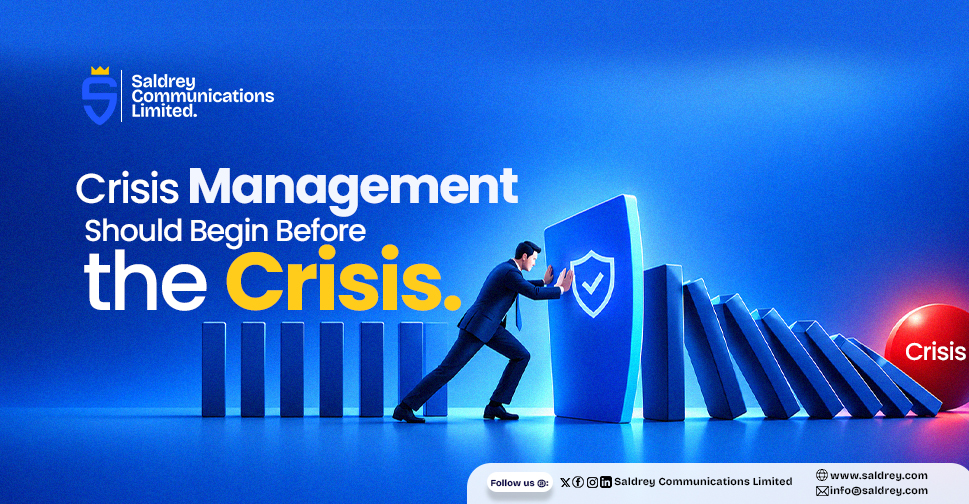

Crisis Management Should Begin Before the Crisis
A crisis rarely announces itself before it happens.
For organizations, the ability to respond effectively to a crisis is often determined long before the first signs of trouble appear. While crisis management is commonly associated with damage control and response, effective crisis communication begins with preparation. It is better to envision a crisis than to enter one unprepared.
Why Envisioning a Crisis Matters
Envisioning potential crises allows organizations to identify vulnerabilities, anticipate stakeholder concerns, and consider how different scenarios could affect their reputation, operations, employees, customers, and other stakeholders. It is an exercise in looking at the organization honestly, from the outside in, rather than waiting for the outside world to do that looking for them under far less forgiving circumstances.
This kind of foresight does not require a crystal ball. It requires a willingness to sit with uncomfortable possibilities long enough to plan for them. Most organizations already know, on some level, where their soft spots are the process that has never been stress-tested, the spokesperson who has never faced a hostile question, the department that finds out about problems last. Envisioning a crisis simply means naming those soft spots deliberately instead of hoping they never get tested.
This means asking difficult questions before they become urgent:
- What could go wrong?
- Who could be affected?
- What information would stakeholders need?
- Who is responsible for communicating?
- How quickly should the organization respond?
- And what actions could make the situation worse?
Each of these questions forces a different kind of clarity. Asking what could go wrong pushes an organization to map its vulnerabilities across operations, leadership, and public perception, rather than assuming problems will only ever come from one predictable direction. Asking who could be affected widens the lens beyond customers to employees, partners, investors, and the communities the organization operates in, each of whom may need a different message, delivered a different way. Asking what information stakeholders would need forces a distinction between what the organization wants to say and what the audience needs to hear in order to trust the response. And asking what actions could make the situation worse is, in many ways, the most valuable question of all, because it’s usually silence, defensiveness, or a mistimed statement that turns a manageable issue into a lasting one.
These questions are not an admission that an organization expects to fail. They are part of responsible risk management.
What Happens Without Preparation
When a crisis occurs, there is often little room for uncertainty. Delayed responses, inconsistent messaging, unclear responsibilities, or poorly considered statements can intensify an already difficult situation. An organization that is thinking through its options for the first time in the middle of a crisis is already behind.
This is where the cost of skipping preparation becomes visible. Delayed responses leave a vacuum that others, often less sympathetic voices, are quick to fill. Inconsistent messaging happens when there is no single, agreed version of events, so different spokespeople end up saying subtly different things, and the gaps between those versions become the story. Unclear responsibilities mean precious hours are lost simply figuring out who is allowed to speak, who needs to approve a statement, and who is accountable for what happens next. And poorly considered statements, made under pressure and without a framework to test them against, tend to raise more questions than they answer.
None of these failures happen because people are careless. They happen because the organization is encountering these decisions for the first time, under the worst possible conditions, with the whole of the crisis already unfolding around them.
Building the Framework for Readiness
Preparation, therefore, is not simply about having a crisis statement ready. It is about building a framework for decision-making, establishing communication channels, identifying key spokespersons, understanding stakeholders, and regularly reviewing potential risks. Each of these pieces, on its own, seems minor. Together, they determine whether an organization can move with clarity and confidence when it matters most.
A decision-making framework means knowing, in advance, who has the authority to approve a response and how quickly that approval can happen, so the organization is not improvising its own chain of command while also managing the crisis itself. Established communication channels mean having the right internal and external lines already open, so information reaches employees, media, regulators, and the public in a coordinated way rather than in a scramble. Identifying key spokespersons in advance means those individuals have had time to understand their role, prepare for difficult questions, and build the kind of credibility that cannot be manufactured overnight. Understanding stakeholders means knowing, ahead of time, who needs to hear from the organization first, and what each group will be listening for. And regularly reviewing potential risks keeps all this current, because the vulnerabilities an organization faces today are rarely the same ones it faced a year ago.
Taken together, these elements do not eliminate the difficulty of a crisis. What they do is remove the added difficulty of figuring out the basics while the crisis is already underway.
Preparedness Over Prediction
The goal is not to predict every crisis. It is to ensure that when the unexpected happens, the organization is not responding for the first time. No amount of planning can anticipate every scenario, and that has never been the point. The point is that an organization which has already asked itself the hard questions, already knows who is responsible for what, and already has a framework for making decisions under pressure, is simply better positioned than one that has not.
Because effective crisis communication is not just about managing the crisis. It is about being prepared for it.
Want to hear how top corporate communications professionals think through crisis readiness before it’s ever needed? Watch the full episode on the Coffee & Comms Podcast YouTube channel: https://youtu.be/qo35QcbPrvQ?si=BtiAXIuk2WDRNzZp Subscribe and share your key takeaways in the comments.